Is Broadway Too Frivolous?
The Times Sure Seems to Think So!

But First… A Word From Our Sponsors One Self-Promoting Author:
Since the last post was all self-promotion, I’m going to try to keep this brief! I’ve been doing a ton of promo for the book—mostly on various podcasts, and much of which will not actually drop until the week the book comes out. I’ll be sure to list those when they’re released. But one thing I had a great time doing was my first ever live TV hit on MSNOW’s Velshi. You can watch Ali Velshi’s wonderful introduction to the culture wars and my book here or you can skip right to our conversation here. I make some points in here I hope to expand on more later so… watch this space.
Here’s also a gentle reminder that the book is available for pre-order! You might have noticed that these days authors put a lot of pressure on their readers to preorder books. It can feel like a real drag! The reason why we do that is that pre-orders are the only metric that book stores have to measure demand for a book. They really can make or break a book’s chances of appearing on book shelves, getting press coverage, and being seen by the public at large. For a work of “serious” non-fiction, it’s more important even than goodreads reviews. (The other reason is that pre-orders get counted towards the first week book sales, which is a way of gaming the bestseller list and getting your book on there, but while having a bestseller would be nice, what I really care about is having a readership and sharing this book with people I think will love it.)
Once the book is out, I will be migrating this newsletter to Beehiiv. If you are already a subscriber, don’t worry, you’ll by automatically migrated. And the newsletter will remain free for the foreseeable future. I might add some premium content later, but there will always be free to read stuff so long as I am writing this thing! A thing that I’m trying to get back to doing regularly!
On that note… onto our main event.
Is Broadway Unserious?
It’s very rare that the Times Opinion section covers theater. And it’s also very rare that the Times Opinion section prints two pieces offering very similar viewpoints on an issue within the same week. So I was quite surprised to read two different pieces in the Times Opinion section about how Broadway needs to be more serious in one week. The first, by Samuel D. Hunter, titled “In Defense of Sad Plays” uses the timelessness of Death of a Salesman to make the point that bumming people out is something plays can do, and that maybe we need more of them in our lives, and worrying that currently the powers that be in the theater are less and less willing to program sad plays: “There’s danger,” Hunter writes, “in the nice evening at the theater. When you ask narrative to always deliver a sanitized product — a pleasant evening, a happy outcome, a fun spectacle — you’re asking it to lie. You’re asking it to obscure the difficult truths and complex failures that define our past and our present.”
The second, by Naveen Kumar, is far more pointed. It is less a capacious call for theater to embrace all that it can do, and instead an argument that theater—and in particular, Broadway—is too “indulgent” of its audiences, and too focused on, “giv[ing] paying audiences what they already want.”
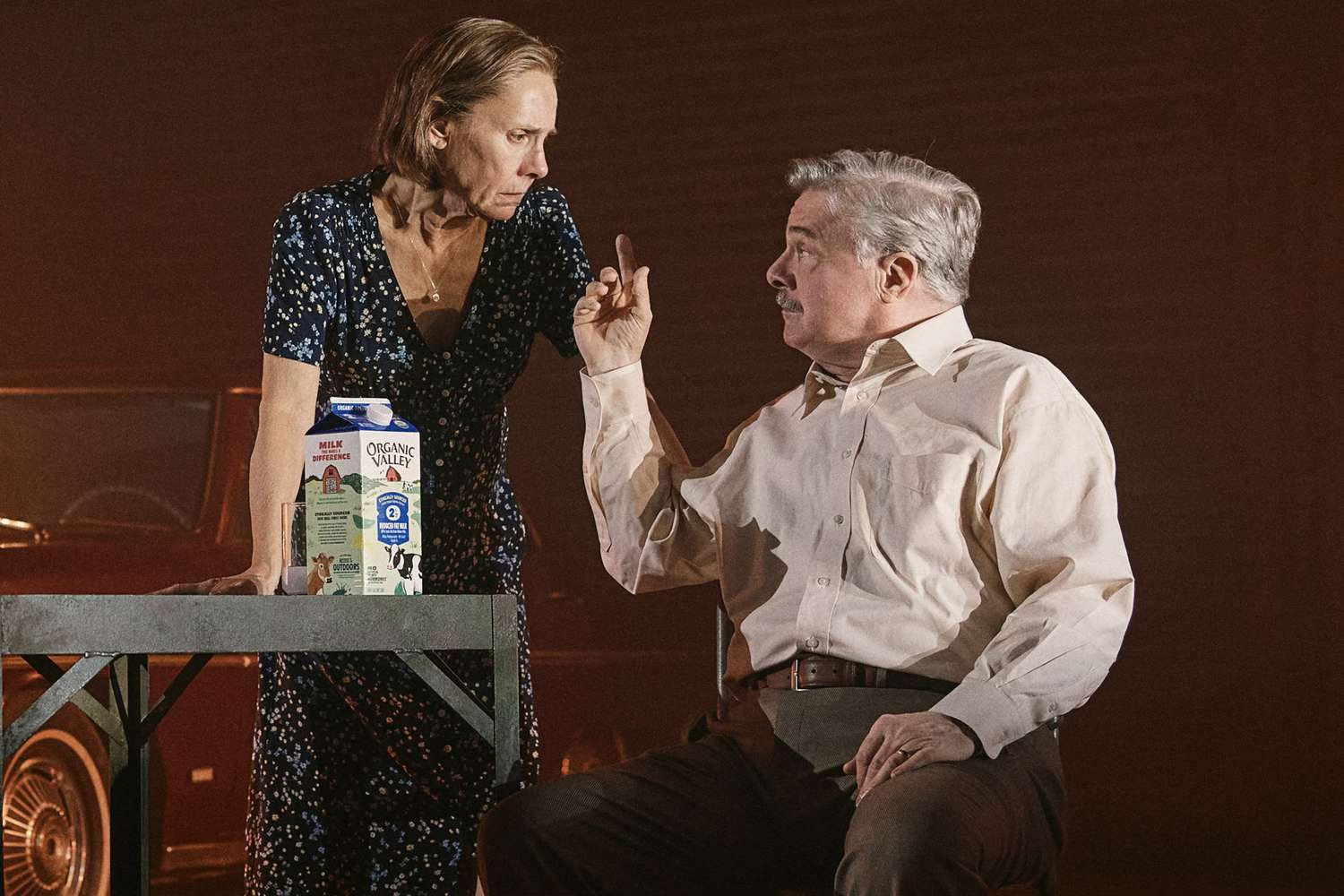
Hunter’s piece—and full disclosure here, I know Sam and his husband a bit, and like them both—makes a point I sympathize with, but the urgency of it puzzles me. I agree that plays can do a lot of things, and most of them strike me as good things to do, and sadness and catharsis are so important that Aristotle writes about them in The Poetics. But is there a crisis when it comes to sadness in the American theater right now? I teach a class in 21st Century New American Plays, and at one point I had an idea to retool my syllabus to only focus on comedies. I texted a playwright friend this idea and he wrote back, “well the problem is there’s almost no important straightforward comedies to teach from that period.” And he’s right. Many plays I teach—An Octoroon, Mr. Burns, Songs of the Dragons Flying to Heaven, etc.—use humor, but none of them could really be called comedies (well, maybe An Octoroon). Comedy is beginning to enjoy a resurgence on Broadway thanks to the success of Oh Mary!, but one reason why that play sent such shocks through the theater world is because it’s a ridiculous, deliberately inane, farce. I had breakfast with a major artistic director last year who wondered out loud what the field had been doing wrong that this play had to be developed completely outside of the non-profit ecosystem. The American theater over the last 25 years, in other words, is suffused with serious and sad plays. This Broadway season saw not only Hunter’s Little Bear Ridge Road, but Liberation (an often funny play that ends with lots of crying), a brilliant and devastating revival of Death of a Salesman, a modern adaptation of Oedipus, Marjorie Prime, a play about death and grief, Joe Turner’s Come and Gone, etc. That’s a lot of sad plays! The only new comedies to appear on Broadway this season are All Out: Comedy About Ambition (an anthology series of pieces about ambition starring various celebrities) and The Balusters, which belongs to a long tradition of American plays exploring extremely serious political questions through absurdity. There’s a handful of additional comedies in the revival category: Art, Becky Shaw, Every Brilliant Thing, and Fallen Angels. But this doesn’t exactly feel like a crisis in sadness to me, and that holds when we go to the non-profit world as well.
Kumar’s piece I have a lot less sympathy for. It’s true that the economic crisis in American culture has had a conservatizing effect throughout basically every arts industry, and I join Kumar in wanting more visionary, challenging work in the world. The pendulum has definitely swung away from confrontational work, although I believe it’ll eventually swing back when someone figures out how to make money off of it. What I balk at is the ideological rigidity that is interwoven throughout his piece, and in particular the assertion that, “theater demands a certain measure of discomfort — that people come willing to stick their necks out and maybe feel the whiz-bang of a guillotine.” (emphasis mine). In what way does theater demand this? Why? To what end? These questions are never really explored, which, along with Kumar’s body of work as a critic, leads me to the conclusion that he is the one who is making this demand.
We must always, as critics, be wary of making our taste the measure of an art form’s health, lest we become commissars in miniature, and that drive is all over the op-ed. The specific kind of work Kumar wants is work that aligns with his politics and values, specifically work that will challenge complacent liberal audiences from the left. Thus, the searing, brutal, devastating (and austere) revival of Death of a Salesman—full disclosure, I’m friends with people involved in the show—gets dismissed as a, “reliable elegy to the working class,” and lumped together with Good Night and Good Luck as a play that reaffirms its liberal audience’s pieties. The Balusters, which (spoiler alert) ends with the person most like its older liberal white audience being deposed from power while the audience cheers his removal, offers the audience too much “forgiveness” because it’s funny. Meanwhile, Liberation (a great play, to be clear) comes in for celebration even though it is nothing like the works that “challenge audiences to face up to their latent biases” that Kumar argues Broadway needs to get back to. In fact, Kumar’s astute description of Liberation sounds like the exact opposite of what he says he wants in the first half: it’s “an anthropological and historical excavation of the question on pretty much every liberal’s mind: How did we try so hard to change the world for the better and still wind up here?” that becomes, “a communal grieving ritual, the kind our society sorely lacks and that theater can deliver at its best.”
I agree with this! But cathartic communal grieving rituals filled with sympathetic characters and good jokes are, definitionally, not particularly challenging. Which is fine! Theater can do a lot of things! One of the things most Broadway shows need to do is make money, because they are commercial ventures. The Times piece acknowledges that the challenging and thorny works programmed as we returned from covid flopped, and that this explains why more small-c conservative, reliable winners are finding their way to Broadway, often written by and starring white people. To some extent, this is the whole ball of wax. I am way further to the left than the median Broadway theatergoer too, but it’s hard for me to really think that people should lose their shirt so I can see more work that reflects my worldview.
A book I return to a lot is Rita Felski’s Uses of Literature. It’s a book I really think anyone who is interested in the arts and criticism should read. Yes, it’s a little academic, and it only focuses on books, but what I love about it is Felski’s capacious examination of the possibilities of art, the way that, through describing what art does she discovers deep purpose and power within it. Felski breaks down the uses of literature into four main categories, and then explores how each function works and what it’s effect on the reader is. Recognition is where we are able to see ourselves within art, enchantment is where we get swept away into a great story (it’s also where the everyday becomes estranged), knowledge is pretty self-explanatory, and shock is where work transgresses in some way that wakes us up and makes us see the world anew. All of these are valuable and important. They are all “uses.”
A fifth I’d add for theater specifically is communion. And while making money is a function theater is really bad at, communion is something at which it excels. Looking at this last season–and with the caveat that Broadway seasons are so dependent on theater availability that we should all be cautious of reading too much into them—it’s providing space for community that I see theater doing a lot of. Liberation, as Kumar notes, is a great example of this. But so is Cats: The Jellicle Ball, which ports the (execrable) Andrew Lloyd Webber musical into the drag ballroom scene, providing space for the celebration of LGBTQ life in all its fabulousness. The Rocky Horror Show, a musical about a pansexual alien who turns two hapless squares on to kink culture, brings the weirdos and queers out in droves. Beetlejuice did the same for the tween set. Every Brilliant Thing, a participation-heavy life-affirming response to depression, creates a community of joy and resilience in real time. The musical Ragtime is, like Liberation, a communal grieving ritual for the lost utopian dream of an interracial, polyglot America where we can all be equal and free together. Joe Turner’s Come and Gone puts the community around a boarding house during the Great Migration on stage, and digs into the deep mysteries of what it means to belong to an identity. On the other end, Little Bear Ridge Road is about one of the great problems facing our nation: loneliness. So, to some extent, is Tracy Letts’s incendiary thriller Bug.
Whether you like all these shows or not, are these not great examples of what theater can do?
Culture Diary, June 2-June 11:
Knicks in Five, Babey!!!
Also… Over the last week, I set aside the novel Bomarzo by Manuel Mujica Lainez unfinished. Despite this… I recommend it? I loved what the book is doing… it’s a kind of I Claudius memoir about an Italian nobleman during the renaissance, and chronicles his gradual turn towards both a love of art and a sociopathic pursuit of his own interests. The back of the book describes it as like one of Poe’s Italian tales as written by Proust and that’s fairly accurate! Lots of long, winding sentences and rapturous ekphrastic passages. So if I liked it so much, why didn’t finish it? Well, it’s nearly 700 pages long, and by page 400 I felt like it had exhausted the moves available to it, and the repetition of those moves had stopped being pleasurable for me. In an odd way, it’s not a book that needs to be finished so much as lived in for a while. It helps to have Wikipedia open so you can look up who every person he meets is.
I also saw Can I Be Frank? And The Rocky Horror Show, both directed by Sam Pinkleton. Can I Be Frank? Is one of the best things I’ve seen all year in any medium. I’m hesitate to describe it at all, as I actually think it works better with no prior knowledge, but it’s a show in which the performance artist and comic Morgan Bassichis tries to recreate the work of Frank Maya, a performance artist and comic who died of AIDS mere months before the introduction of the triple cocktails would transform the AIDS crisis. He was also on the verge of popular breakout success as an out gay man, an incredible feat. Even more incredible is the word-drunk, wild, tonal fata morgana that Bassichis creates on stage. I was left in speechless awe when it was over. The Rocky Horror Show is about—well, come on, you know the Rocky Horror show already, right? I’ll admit that I’ve never really liked Rocky Horror as a piece (even with full participation, I find the movie exhausting), and thus, while I thought the production was filled with delightful comic invention and great performances, I ultimately was left a little cold by the experience. As a communal experience though, it was a blast, and it was great to share with my queer kid an important part of the American queer canon.
On TV, we’re watching Widow’s Bay, like everyone else I know. When I guest-hosted Gabfest, (for the last time!!!) Sam Adams said that, having seen the whole season, he felt like it became way less interesting as it leaned into horror and the mystery-box-of-it-all. We’re one episode away from the finale, and I have to say, I’m not finding that to be the case. What makes the show work is the specificity of the performances and world, and both of those remain strong as we go down the home stretch.
I appreciate this perspective! And this is coming from someone who believes that the arts are inherently political and a very serious tool for revolution. Nearly every show I see of late is very dramatic and sad, which also seems to be what many young writers feel they should write in order to be “legitimate” artists. And yet, comedy IS catharsis, and collective joy is radical.
The idea that "theater demands a certain measure of discomfort" has never sat well with me, either—in 2015, when I was writing for a theater blog in San Francisco, I tried to articulate the counter-argument: https://sftheaterpub.wordpress.com/2015/10/15/hi-ho-the-glamorous-life-uncomfortable-thoughts/ (I basically stand by all of this, even if my concluding paragraphs about "Hamilton" seem, well, a bit 2015.) Like you, I keep coming back to the thought that it seems unfairly limiting to say that there is only *one* purpose to theater--and it's a purpose that many great theater artists would not have understood, at that! I would bet that throughout the ages, far more theater-makers have come to the art form out of a desire to create community, than out of a desire to stir the pot and provoke discomfort.